The History of Calculation
From counting stones to quantum computing: humanity's quest to compute.
Today, we carry supercomputers in our pockets. But for most of human history, complex math was a manual, painstaking labor. The history of the calculator is the history of human civilization itself.
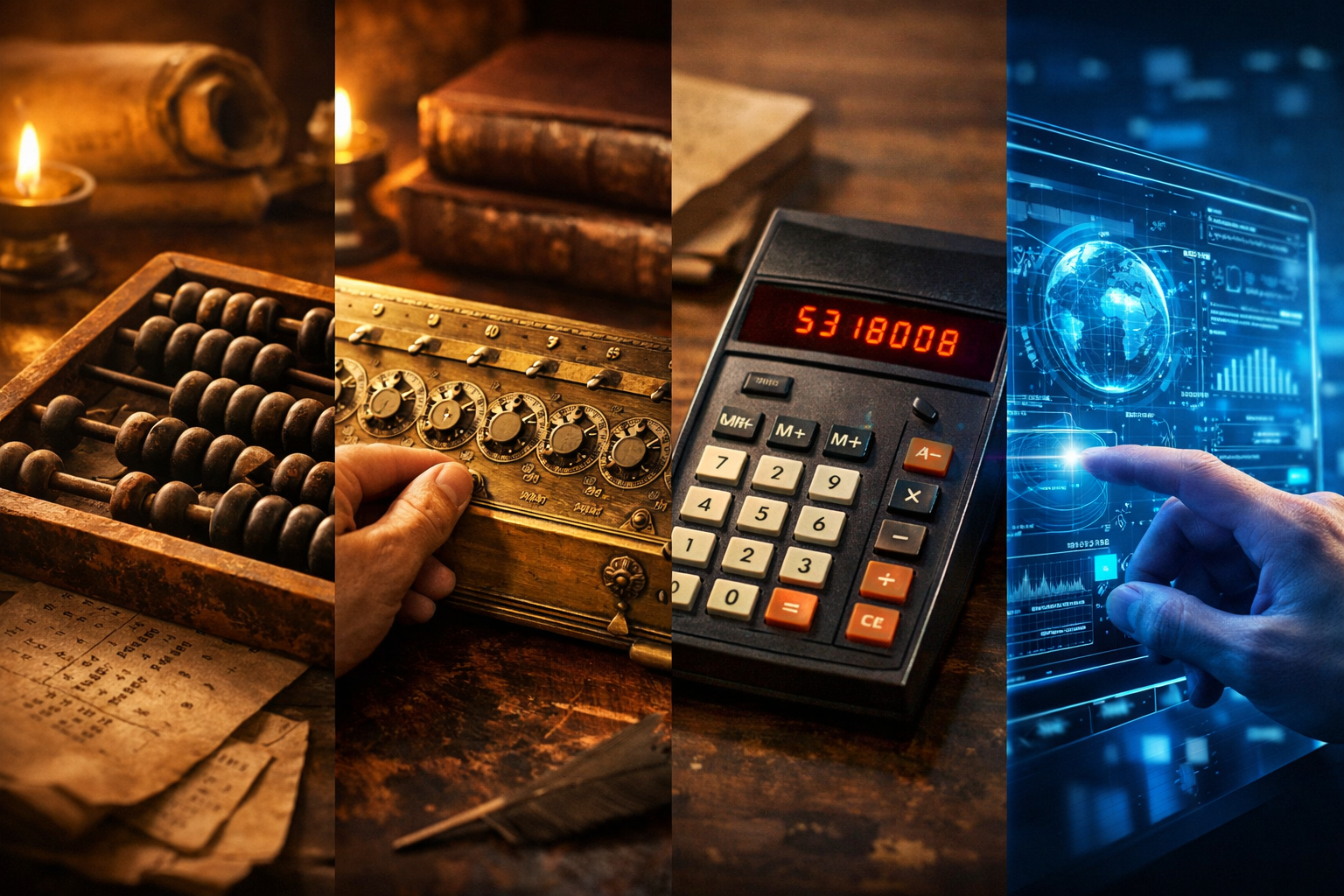
2700 BC: The Abacus
The Sumerians invented the first tracking system, but the frame-and-bead abacus we recognize appeared in China. It allowed merchants to perform rapid addition and subtraction without writing.
1642: Pascal's Calculator
Blaise Pascal, at age 19, invented the chemical "Pascaline" to help his father with taxes. It was a brass box with gears that could add and subtract. It was the first mechanical calculator.
1970s: The Silicon Revolution
The invention of the microprocessor changed everything. Calculators like the HP-35 (1972) became the first handheld scientific calculators, replacing the slide rule and sending rockets to the moon.
Modern Day & Beyond
Today, physical calculators are becoming rare, replaced by software like the one on this website. But the underlying math remains the same. The future lies in quantum computing, which will solve problems in seconds that would take today's supercomputers thousands of years.
Did You Know?
The first computer programmer was a woman named Ada Lovelace, who wrote an algorithm for Charles Babbage's mechanical "Analytical Engine" in the 1840s—a century before the first electronic computer was built.