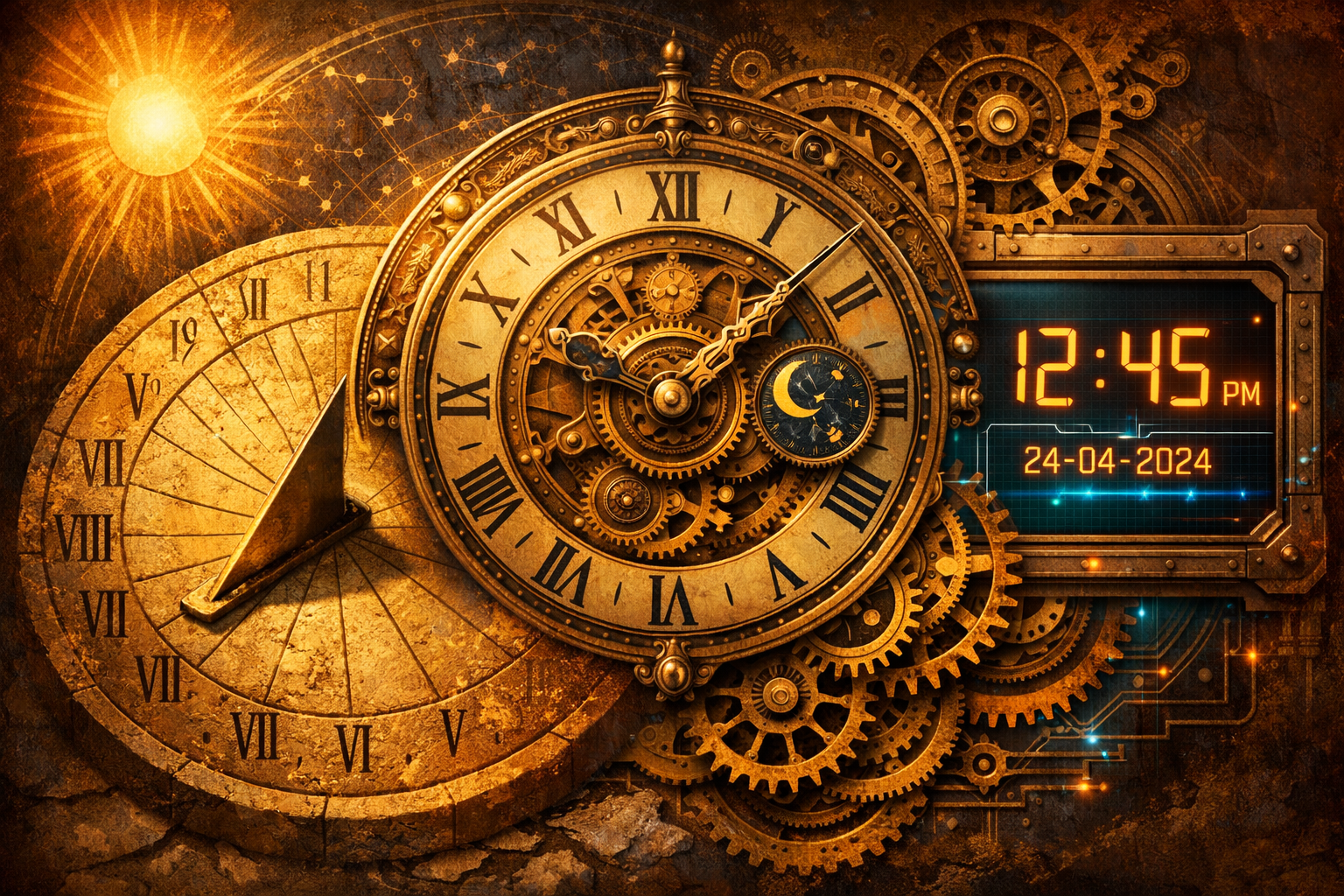
Why 60 Seconds? The History of Time
Why isn't a minute 100 seconds? The answer takes us back 5,000 years.
We use the decimal system (base 10) for almost everything: money, distance (metric), and weight. So why is time measured in 60s and 24s? It seems messy, but it's actually a brilliant legacy from ancient civilizations.
The Babylonians and Base 60
The division of the hour into 60 minutes and the minute into 60 seconds comes from the Babylonians, who lived in Mesopotamia (modern-day Iraq) over 4,000 years ago.
They used a sexagesimal (base 60) numbering system. Why 60? Because it's a "highly composite number." It can be divided evenly by 1, 2, 3, 4, 5, 6, 10, 12, 15, 20, and 30. This made calculations—especially fractions—much easier for early astronomers and merchants without calculators.
Imagine dividing 100 vs 60:
- 100 ÷ 3 = 33.333... (Messy!)
- 60 ÷ 3 = 20 (Clean!)
This flexibility is why we still use base 60 for time and geometry (360 degrees in a circle).
The Egyptians and the 24-Hour Day
While Babylonians gave us the 60, the Egyptians gave us the 24-hour day.
They used base 12 (duodecimal), likely counting the three joints on each of their four fingers (excluding the thumb).
- They divided daylight into 10 hours.
- They added 1 hour for dawn and 1 hour for dusk.
- This made 12 hours of daylight.
- They mirrored this for the night, creating a 24-hour day.
Standardizing the Second
For centuries, the length of an hour varied by season (summer hours were longer than winter hours). It wasn't until the invention of mechanical clocks in the 14th century that hours became fixed length.
Today, we don't rely on the earth's rotation, which is slightly irregular. Since 1967, the second has been defined by atomic clocks measuring the vibration of cesium-133 atoms. It is the most precise measurement humanity has ever achieved.
Calculate History Yourself
Want to know how many seconds have passed since the year 2000? Or calculate the exact duration of a historical event?