Real-World Applications of Triangles in Architecture
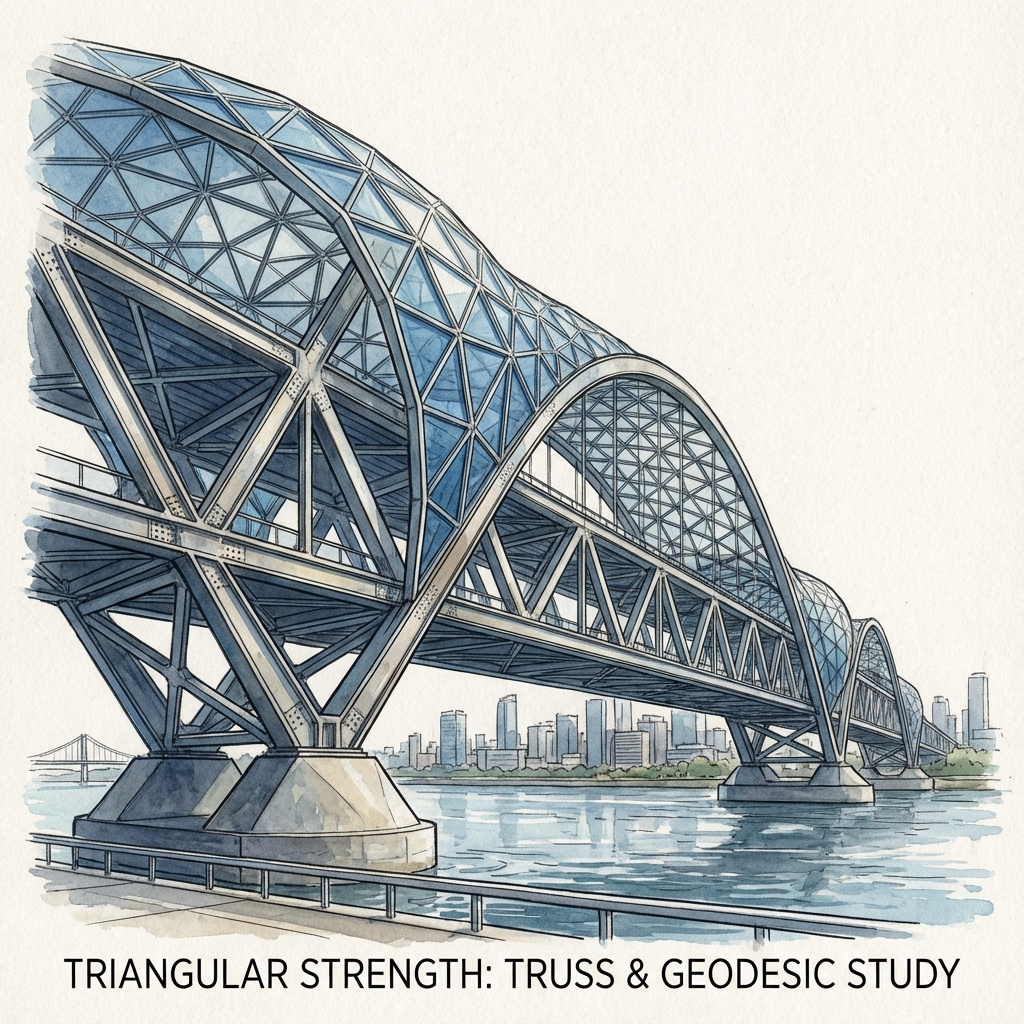
When you look at a bridge, a crane, or the roof of a house, you'll likely see one shape repeated over and over: the triangle. But why is this simple three-sided polygon so prevalent in construction and architecture?
The Strongest Shape
The triangle is considered the strongest shape in engineering. Unlike a rectangle, which can be distorted into a parallelogram with pressure, a triangle is rigid. Its shape cannot be altered without changing the length of one of its sides.
This property makes triangles ideal for bearing loads. When a force is applied to the top vertex of a triangle, it is distributed down the two sides to the base, preventing collapse.
Trusses and Bridges
One of the most common applications is the truss. A truss is a structure comprising five or more triangular units constructed with straight members.
- Truss Bridges: You've seen them everywhere. The triangular lattice allows bridges to span long distances while supporting heavy traffic (trains, cars) with minimal material.
- Roof Trusses: Most residential roofs use triangular trusses to support the weight of the roof tiles and snow load.
Famous Examples
1. The Eiffel Tower (Paris, France)
Gustave Eiffel's masterpiece is essentially a giant framework of triangles. This lattice structure allows wind to pass through, reducing wind load, while providing immense structural integrity to reach its record-breaking height.
2. The Louvre Pyramid (Paris, France)
Designed by I.M. Pei, this modern glass and metal structure consists of 603 rhombus-shaped and 70 triangular glass segments. It's a stunning example of geometry in modern design.
3. Geodesic Domes
Popularized by Buckminster Fuller, geodesic domes are spherical structures made up of a network of triangles. They are incredibly lightweight yet strong, enclosing the largest volume of space with the least amount of surface area.
Conclusion
Triangles are more than just a math concept; they are the backbone of our built environment. Next time you see a construction site, look for the triangles holding it all together.